1884 European colonization and trade in Africa are officially regulated at the international Berlin Conference, formalizing the “Scramble for Africa” among European powers
BUT WHY ?
APPARENTLY THE HAVE MORE RESOURCES !
The top 10 countries by total natural resource value encompass a mix of large deposits of minerals, metals, fossil fuels, and renewable resources. Here’s an overview of the ranking and the resources each country is known for:
- Russia
- Resources: Natural gas, coal, timber, oil, iron ore, gold, and precious metals.
- Russia’s vast land is rich in a wide array of resources, particularly oil, natural gas, and coal, which are major exports.
- United States
- Resources: Coal, timber, natural gas, oil, copper, gold, and other minerals.
- The U.S. has one of the largest coal and natural gas reserves and is a leading oil producer due to innovations in extraction technology.
- Saudi Arabia
- Resources: Oil and natural gas.
- Known for having the second-largest proven oil reserves, oil exports drive Saudi Arabia’s economy, making it a major player in the global energy market.
- Canada
- Resources: Timber, oil sands, natural gas, potash, and other minerals.
- Canada holds large deposits of oil sands, especially in Alberta, and is also rich in minerals like potash and iron.
- China
- Resources: Coal, rare earth metals, gold, and other minerals.
- China’s large coal deposits and near-monopoly on rare earth metals are essential for high-tech manufacturing globally.
- Iran
- Resources: Oil and natural gas.
- Iran has significant oil reserves and the world’s second-largest natural gas reserves, making it a powerhouse in hydrocarbon resources.
- Brazil
- Resources: Timber, iron ore, gold, and other minerals.
- Brazil is known for its rich iron ore reserves, which supply global steel production, and the Amazon basin, which has vast timber resources.
- Australia
- Resources: Coal, iron ore, gold, natural gas, and uranium.
- Australia is a top producer of iron ore and coal and also has large uranium and gold reserves, which support its mining-driven economy.
- Iraq
- Resources: Oil and natural gas.
- Iraq has large proven oil reserves and is a significant oil exporter in the Middle East, heavily relying on petroleum revenue.
- Venezuela
- Resources: Oil.
- Venezuela holds some of the largest oil reserves in the world, though production has been limited by economic and political challenges.
These rankings can vary depending on the prices of specific resources, exploration successes, and economic conditions affecting extraction.
You said:
why are African Countries not in this list
ChatGPT said:
African countries have substantial natural resources, but several factors limit their appearance on lists ranking total natural resource value, especially when compared to resource-rich giants like Russia, the U.S., and Saudi Arabia. Here’s a breakdown of why African countries often don’t make the top ten:
1. Resource Quantity and Global Reserves Share
- While Africa is home to vast deposits of resources like gold, diamonds, cobalt, platinum, oil, and natural gas, some of these reserves are not as extensive as those in countries like Russia or Saudi Arabia.
- For example, Nigeria and Angola have substantial oil reserves, but these are much smaller than those in the Middle East, limiting their influence on global oil markets.
2. Underdeveloped Extraction and Processing Infrastructure
- Many African countries lack the infrastructure needed to fully exploit their resources, such as mining technology, pipelines, refineries, and export facilities.
- This makes it difficult to convert raw natural resources into economically valuable outputs at a scale seen in more industrialized countries.
3. Political Instability and Conflict
- Regions rich in resources often face political instability, conflicts, and governance challenges that hinder effective resource extraction.
- For instance, the Democratic Republic of Congo (DRC) is one of the world’s largest producers of cobalt and has vast mineral resources, yet political and security issues significantly restrict development.
4. Limited Global Market Influence
- Many African countries are major producers of certain commodities (like South Africa for platinum and the DRC for cobalt), but these resources may not be as highly valued as oil and gas on the global market.
- The global economy still prioritizes fossil fuels for energy, which has historically overshadowed the value of metals and minerals in total resource assessments.
5. Environmental and Social Costs of Extraction
- African nations are increasingly aware of the environmental and social impacts of resource extraction. Some governments are limiting extraction or slowing projects to preserve ecosystems, such as the Congo rainforest, which is critical for biodiversity and carbon sequestration.
6. Economic Dependency and Export Limitations
- While Africa holds about 30% of the world’s mineral reserves, these resources are often exported in raw form rather than processed, which limits their value.
- Many African countries are economically dependent on one or two primary exports, making them vulnerable to market fluctuations.
Examples of Resource-Rich African Countries
- Nigeria: Africa’s largest oil producer, with oil being the main driver of its economy.
- South Africa: Holds significant deposits of gold, platinum, and coal.
- Democratic Republic of Congo (DRC): The world’s largest cobalt reserves, essential for batteries in electronics and electric vehicles.
- Angola: Large oil reserves and one of the top oil producers in Africa.
In summary, while Africa is rich in natural resources, infrastructure gaps, political factors, and global market dynamics mean that their overall value hasn’t yet translated into top rankings on a global scale. However, with growing investment, political stability, and better resource management, African countries have the potential to rise significantly in future resource value rankings.
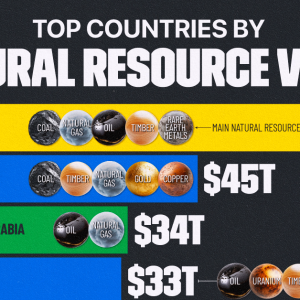
Ranked: Top Countries by Natural Resource Value
Natural resources are the backbone of modern manufacturing, necessary to produce everything around us.
According to 2021 data from Statista, 10 countries dominate the global natural resource landscape, each holding vast reserves critical for various industries.
Russia’s $75 Trillion in Natural Resources
Russia leads the pack with natural resources valued at $75 trillion, largely consisting of coal, natural gas, oil, and rare earth metals. At the end of 2018, Russia’s Ministry of Natural Resources and the Environment valued the country’s mineral reserves at approximately $1.44 trillion.
In terms of global share, Russia is unmatched in natural gas, holding the world’s largest proven reserves at 1.32 quadrillion cubic feet as of 2020—nearly 20% of the global total. Russia also ranks as a gold powerhouse.
The United States ranks second, with an estimated $45 trillion in natural resources, including coal, timber, natural gas, and valuable metals like gold.
| Country |
Main Natural Resources |
Value (in trillion USD) |
| 🇷🇺 Russia |
Coal, natural gas, oil, gold, timber, rare earth metals |
75 |
| 🇺🇸 U.S. |
Coal, timber, natural gas, gold, copper |
45 |
| 🇸🇦 Saudi Arabia |
Oil, timber |
34 |
| 🇨🇦 Canada |
Oil, uranium, timber, natural gas, phosphate |
33 |
| 🇮🇷 Iran |
Oil, natural gas |
27 |
| 🇨🇳 China |
Coal, rare earth metals, timber |
23 |
| 🇧🇷 Brazil |
Gold, uranium, iron, timber, oil |
22 |
| 🇦🇺 Australia |
Coal, timber, copper, iron ore, gold, uranium |
20 |
| 🇮🇶 Iraq |
Oil, phosphate rock |
16 |
| 🇻🇪 Venezuela |
Iron, natural gas, oil |
14 |
In Saudi Arabia and Canada, oil wealth drives natural resources, placing these countries third and fourth on the list. Saudi Arabia, with its vast oil fields, has been a leader in global energy markets. Canada, on the other hand, also benefits from substantial uranium deposits and is home to some of the world’s largest lumber companies.
Further down the list, China has vast coal reserves, positioning it as the top producer of the fuel.
Mineral-rich Brazil and Australia are leading producers of metals like iron ore, while Australia is also a top exporter of coal.