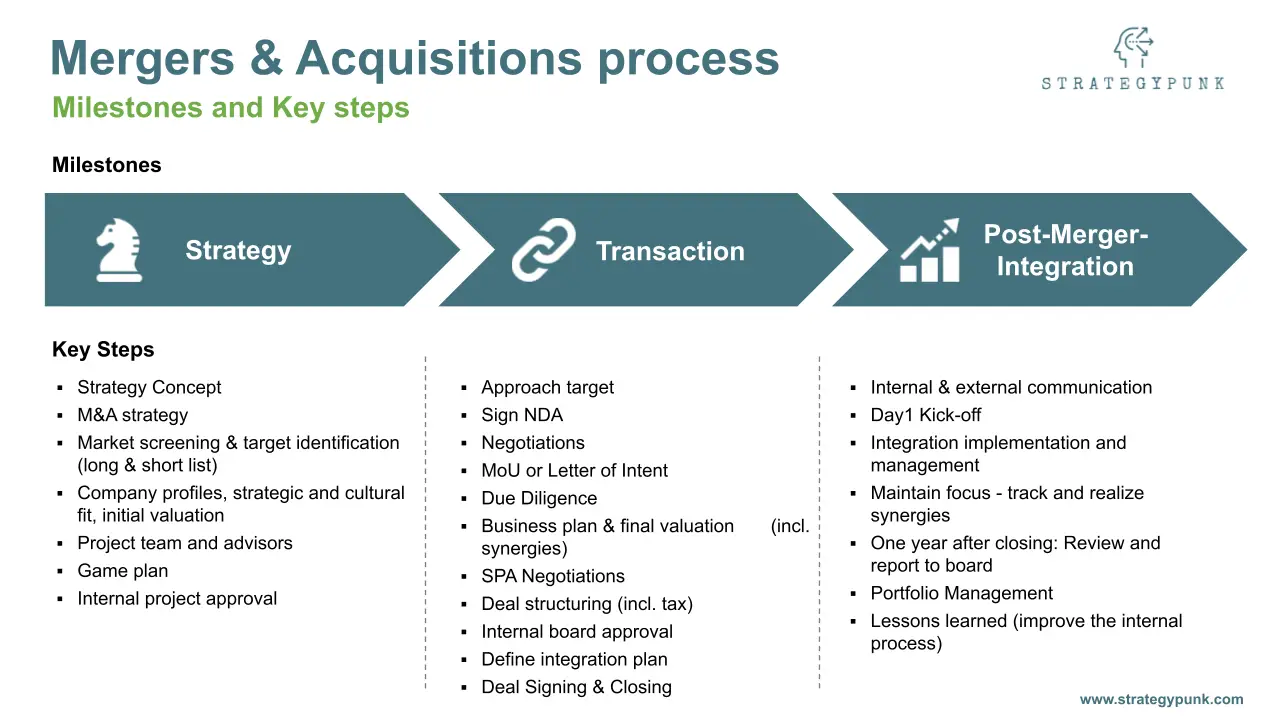
Mergers and acquisitions, or M&A for short, involves the process of combining two companies into one. The goal of combining two or more businesses is to try and achieve synergy—where the whole (new company) is greater than the sum of its parts (the former two separate entities).
Mergers occur when two companies join forces. Such transactions typically happen between two businesses that are about the same size and which recognize advantages the other offers in terms of increasing sales, efficiencies, and capabilities. The terms of the merger are often fairly friendly and mutually agreed to and the two companies become equal partners in the new venture.
Acquisitions occur when one company buys another company and folds it into its operations. Sometimes the purchase is friendly and sometimes it is hostile, depending on whether the company being acquired believes it is better off as an operating unit of a larger venture.
The end result of both processes is the same, but the relationship between the two companies differs based on whether a merger or acquisition occurred.
Benefits of combining forces
Some of the benefits of M&A deals have to do with efficiencies and others have to do with capabilities, such as:
Improved economies of scale. By being able to purchase raw materials in greater quantities, for example, costs can be reduced.
Increased market share. Assuming the two companies are in the same industry, bringing their resources together may result in larger market share.
Increased distribution capabilities. By expanding geographically, companies may be able to add to their distribution network or expand its geographic service area.
Reduced labor costs. Eliminating staffing redundancies can help reduce costs.
Improved labor talent. Expanding the labor pool from which the new, larger company can draw can aid in growth and development.
Enhanced financial resources. The financial wherewithal of two companies is generally greater than one alone, making new investments possible.
Potential drawbacks
Although mergers and acquisitions are expensive undertakings, there are potential rewards. And there are disadvantages, or reasons not to purchase an acquisition, including:
Large expenses associated with buying a company, especially if it does not want to be acquired. (If an investor has a controlling interest in another company, however, it may not have a choice regarding whether it is acquired.)
Higher legal costs, which can be exorbitant if a company does not want to be acquired.
The opportunity cost of having to forego other deals in order to focus on bringing two companies together.
The possibility of a negative reaction to a merger or acquisition, which drives the company’s stock price lower.
M&A is a growth strategy corporations often use to quickly increase its size, service area, talent pool, customer base, and resources in one fell swoop. The process is costly, however, so the businesses need to be sure the advantage to be gained is substantial.
Mergers and acquisitions (M&A) are transactions that involve the consolidation of companies or their major business assets through financial transactions between companies. In simpler terms, it refers to when one company takes over another company or when two companies combine to form a new company.
Types of Mergers and Acquisitions
There are several different types of M&A transactions, but they can be broadly categorized into two main categories:
-
Mergers: A merger occurs when two or more companies combine to form a new company. The new company is typically created by exchanging the shares of the merging companies for shares of the new company.
-
Acquisitions: An acquisition occurs when one company takes over another company and assumes control of its assets and liabilities. The acquiring company typically pays for the target company with cash, shares of its own stock, or a combination of both.
Reasons for Mergers and Acquisitions
Companies pursue M&A transactions for a variety of reasons, including:
-
To increase market share: By combining with or acquiring a competitor, a company can increase its market share and become more dominant in its industry.
-
To expand product offerings: M&A can be a way for a company to expand its product offerings and reach new customers.
-
To achieve economies of scale: By combining operations, companies can reduce costs and achieve economies of scale.
-
To access new technologies: Acquiring a company with cutting-edge technology can give a company a competitive advantage.
-
To diversify business: M&A can be a way for a company to diversify its business and reduce its exposure to risk.
Impact of Mergers and Acquisitions
M&A transactions can have a significant impact on the companies involved, as well as on the broader economy. Some of the potential benefits of M&A include:
-
Increased efficiency: Combining operations can lead to cost savings and increased efficiency.
-
Expanded market reach: M&A can help companies expand their market reach and reach new customers.
-
Access to new technologies: Acquiring a company with cutting-edge technology can give a company a competitive advantage.
-
Increased profits: M&A can lead to increased profits for the companies involved.
However, there are also some potential risks associated with M&A, such as:
-
Integration challenges: Integrating two or more companies can be a complex and challenging process.
-
Cultural clashes: Combining different corporate cultures can lead to conflict and resistance to change.
-
Job losses: M&A can sometimes lead to job losses as companies consolidate operations.
-
Antitrust concerns: M&A transactions can raise antitrust concerns if they lead to excessive market power.
Overall, M&A can be a powerful tool for companies to achieve their strategic goals. However, it is important to carefully consider the potential risks and benefits before pursuing an M&A transaction.
or to provide other services to the company.
